Under the proposal, staking rewards would gradually decline as the percentage of ETH locked for network security increases. If staking reached 50% of Ethereum’s total supply, new protocol issuance could eventually fall to zero.
The proposal was authored by Ethereum researchers including Ethereum Foundation researcher Justin Drake and Ethereum Community Conference co-founder Jerome de Tychey.
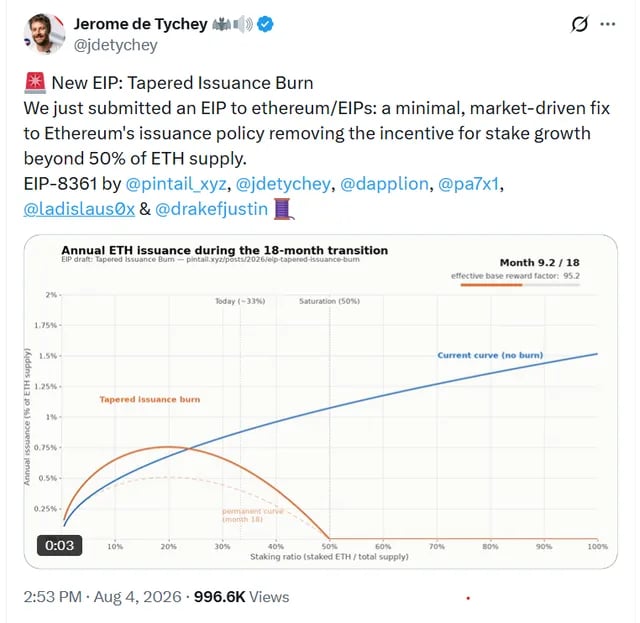
Jerome de Tychey's proposal discussion
The central argument is that Ethereum may already have enough staked ETH to provide sufficient economic security. From this perspective, continuing to increase staking rewards could create unnecessary dilution for ETH holders who do not stake.
Ethereum Already Has More Than 40 Million ETH Staked
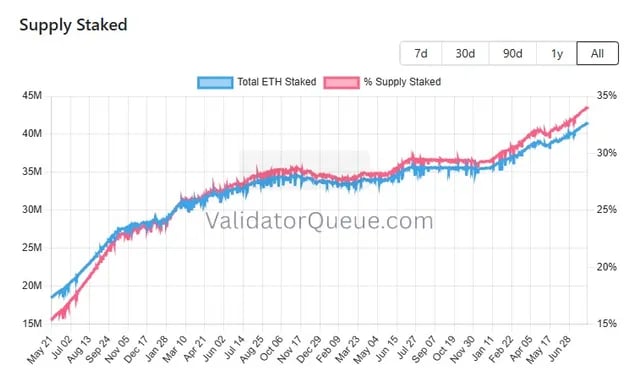
Ethereum currently has approximately 41.5 million ETH staked, representing about 34.07% of the total ETH supply, according to Validator Queue. The current staking yield is around 2.67%.
Ethereum Validator Queue data
The amount of staked ETH has also increased significantly during 2026, rising roughly 15% since the beginning of the year.
Supporters of EIP-8363 argue that this continued growth could eventually result in excessive staking participation without delivering proportional improvements to Ethereum’s security.
However, opponents believe market forces may naturally limit staking participation as yields decline.
Critics Say Ethereum May Already Be Approaching a Natural Staking Ceiling
Bitwise head of Ethereum client partnerships Steve Berryman argues that Ethereum does not necessarily need a major change to its issuance policy.
According to Berryman, staking yields approaching 2% could naturally reduce the incentive for additional ETH holders to lock up their assets.
He also points to the recent involvement of large institutional participants, including Bitmine and BlackRock, as an important factor behind the increase in staked ETH.
Once these institutions complete their planned staking allocations, participation could naturally begin to stabilize.
From this perspective, critics question whether Ethereum needs to change its monetary policy to solve a problem that market incentives may already be addressing.
Does Ethereum Really Have an Issuance Problem?
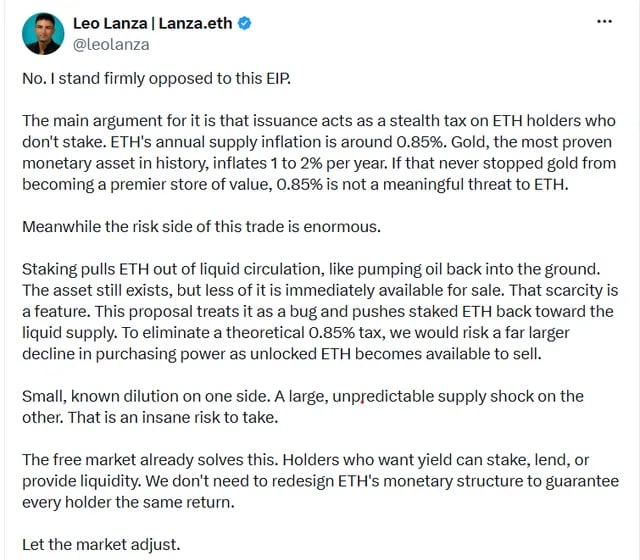
Ethereum commentator Leo Lanza has also criticized the proposal, challenging the idea that staking rewards represent a significant burden on non-staking ETH holders.
Leo Lanza's comments on EIP-8363
Ethereum's annual inflation rate remains below 1%, according to the arguments presented by opponents of the proposal.
Lanza argues that the market should be allowed to determine the appropriate level of staking participation rather than relying on another major adjustment to Ethereum's issuance model.
The debate therefore goes beyond validator rewards. It raises a broader question about how frequently Ethereum should modify its monetary policy as the network evolves.
DeFi Could Be One of the Biggest Areas Affected
One of the strongest objections to EIP-8363 comes from the decentralized finance sector.
Ethereum's staking ecosystem has become deeply integrated with DeFi through liquid staking tokens and other yield-bearing assets. These products are frequently used as collateral in lending markets and as components of broader DeFi strategies.
Ether.fi founder Mike Silagadze argues that sharply reducing staking rewards could have consequences across this ecosystem.
Mike Silagadze's comments
A reduction in staking returns could make some staking-related DeFi products less attractive, potentially affecting liquidity, collateral markets and demand for liquid staking derivatives.
Aave founder Stani Kulechov has also expressed concern that reducing the return available to ETH holders could encourage some investors to move capital toward other yield-generating assets.
Stani Kulechov's comments
This creates a difficult trade-off for Ethereum. Lower issuance could strengthen the network's monetary profile, but weaker staking economics could also reduce activity throughout parts of its DeFi ecosystem.
Smaller Validators Could Face Greater Pressure
Another major concern is the potential effect on Ethereum's validator distribution.
Supporters of the proposal argue that reducing staking incentives could discourage large custodians and liquid staking providers from accumulating excessive amounts of ETH.
Critics see the opposite risk.
Independent validators have higher relative operating costs than large staking businesses, exchanges and institutional operators. If staking rewards decline substantially, some smaller validators could find participation economically unattractive.
Greg Koumoutsos, technical research lead at the Lido Labs Foundation, argues that Ethereum's security model depends on more than simply the total amount of ETH that is staked.
The network also benefits from operator diversity, censorship resistance, decentralization and resilience.
Under that framework, reducing rewards too aggressively could unintentionally weaken the diversity of Ethereum's validator set.
Could Lower Rewards Increase Centralization?
The proposal's critics argue that large staking operators may be better positioned to survive lower returns because of economies of scale.
Solo validators, meanwhile, must absorb hardware, infrastructure and operational costs themselves.
If staking yields fall significantly, marginal solo validators could exit while large custodians and professional staking providers remain active.
That could create an unintended outcome: a proposal designed partly to prevent excessive staking concentration could actually make large operators more dominant.
The issue is particularly important for Ethereum because decentralization is a core part of the network's security model.
Institutional Investors Want Predictability
The debate also extends to Ethereum's growing institutional market.
Berryman argues that institutional investors place a high value on predictable monetary policy and stable rules.
For large investors, even a relatively small change in staking yields may matter less than the uncertainty created by repeatedly modifying Ethereum's issuance framework.
This is especially relevant as institutional products increasingly offer investors exposure to ETH while incorporating staking strategies.
A predictable staking environment could therefore become an important factor in Ethereum's competition for institutional capital.
Governance Process Faces Criticism
The timing of EIP-8363 has also become part of the controversy.
The proposal was reportedly published only two days before the Aug. 6 deadline for proposals to be considered for the next Ethereum network upgrade.
Critics argue that a proposal capable of affecting staking, DeFi, validator economics and Ethereum's monetary policy deserves a longer period of public discussion.
The disagreement highlights a recurring challenge for Ethereum governance: technical changes can have consequences far beyond the original problem they were designed to address.
The Bigger Question: How Much Should Ethereum Pay for Security?
At the heart of the EIP-8363 debate is a fundamental question about Ethereum's economic model.
Supporters believe Ethereum should avoid issuing new ETH when additional staking provides limited incremental security. Reducing issuance could strengthen ETH's monetary characteristics and reduce dilution for non-stakers.
Opponents argue that staking rewards support much more than raw economic security. They help maintain a diverse validator ecosystem and underpin a large network of DeFi applications and liquid staking products.
The proposal therefore creates competing priorities:
Lower issuance could reduce dilution.
Lower staking rewards could weaken validator incentives.
Smaller returns could pressure solo validators.
Reduced staking activity could affect DeFi liquidity.
Changing monetary policy could create uncertainty for institutions.
A lower staking ratio could potentially reduce concentration.
What Happens Next?
EIP-8363 is still part of an ongoing Ethereum governance debate rather than an implemented protocol change.
The intensity of the response demonstrates how difficult it is to modify Ethereum's monetary policy now that staking has become deeply connected to DeFi, institutional products and the network's validator infrastructure.
Whether Ethereum ultimately moves toward lower staking issuance will depend on further technical analysis, community discussion and governance decisions.
For now, the debate is less about whether staking rewards should simply be higher or lower and more about what Ethereum wants its staking system to accomplish over the long term.
Conclusion
Ethereum's EIP-8363 proposal has opened a much broader debate than its original goal of reducing staking incentives.
Supporters see an opportunity to limit unnecessary issuance once Ethereum reaches a sufficiently high staking ratio. Critics warn that the same change could reduce validator diversity, disrupt DeFi markets and introduce uncertainty for institutional investors.
With more than 41.5 million ETH already staked, the question of how much Ethereum should pay for network security is becoming increasingly important.
The eventual outcome could influence not only validator rewards but also Ethereum's monetary policy, liquid staking sector, DeFi ecosystem and institutional adoption for years to come.