Wedgie Offers an Open-Source Approach to Hardware Wallets
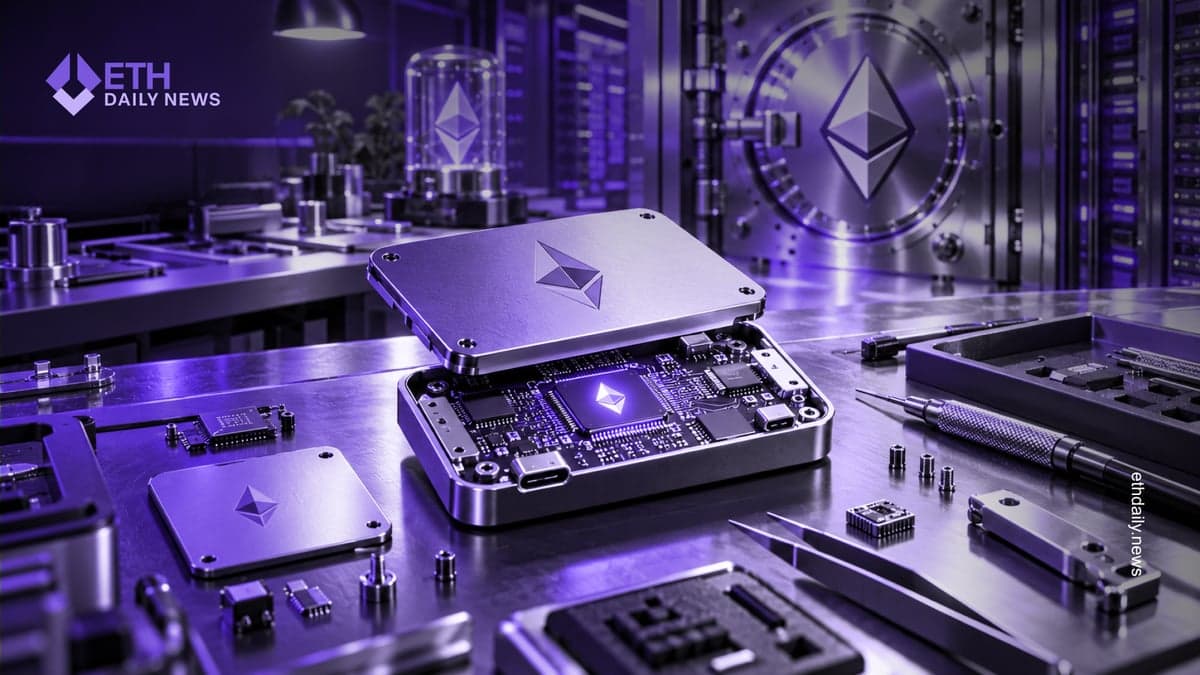
Ethereum developer Austin Griffith has introduced Wedgie, a do-it-yourself hardware wallet designed to make building a crypto signing device more accessible. The project uses three off-the-shelf components: an RP2040 Pico microcontroller board, a Waveshare Pico-LCD-1.3 screen hat and a secure chip.
The components fit together without soldering, and users can print the device’s case themselves. The project is designed to sign Safe multisignature transactions, which require authorization under a predefined set of signing rules. The private key remains inside the secure chip, and completing a signature requires the user to press the device’s green button.
Wedgie’s hardware, case, firmware and website are licensed under the MIT License. This allows people to build their own devices, modify the software and hardware designs, fork the project, and sell their own versions. Griffith shared the launch in an announcement on X.
DIY Kits Start at $57
Wedgie is being offered in both unassembled and assembled versions. Unassembled kits start at $57, while assembled units start at $67, including shipping.
The kits include the microcontroller board, LCD screen, secure chip and 3D-printed case. Buyers who want to build the device themselves can use the included components, while those who prefer not to assemble it can choose the more expensive preassembled option.
Orders are currently limited to the United States, with shipping expected within a week. Customers can also pay in USDC on Ethereum, Base and Arbitrum. The project’s open-source licensing gives developers and hardware enthusiasts the option to customize the design beyond the versions sold directly.
Glamsterdam Client Releases Prepare Hoodi for October Upgrade
Ethereum’s development roadmap is also moving forward, with Glamsterdam-ready client releases available for the Hoodi testnet. The network is scheduled to activate the upgrade on October 26, 2026, at 17:42:48 UTC, corresponding to epoch 132,352 and slot 4,235,264.
The Hoodi gas limit is also scheduled to rise to 200 million at the same epoch. Compatible client releases are available from Lodestar, Teku, Nimbus, Besu, Ethrex and Nethermind, with additional client versions expected in the following days. The Ethereum Foundation’s announcement provides the upgrade details.
Glamsterdam includes enshrined proposer-builder separation under EIP-7732, block-level access lists under EIP-7928, and changes to gas pricing that account for state creation and access costs. Node operators must update both their execution and consensus clients before activation to remain compatible with the upgraded testnet.
Hoodi is expected to be the third and final testnet to undergo Glamsterdam before the planned Ethereum mainnet activation later in 2026. The mainnet schedule remains a separate milestone from the Hoodi testnet date.
Lighter Opens Public EVM Devnet
Lighter, an application-specific zero-knowledge rollup on Ethereum focused on perpetual futures trading, has opened the public development network for Lighter EVM. The new environment is an EVM-equivalent rollup built with Axiom and powered by OpenVM.
Lighter EVM operates alongside Lighter Core, allowing smart contracts to access Core accounts, balances, positions, orders and market data synchronously. Asynchronous calls can also be used to place, modify or cancel orders between the two systems. This architecture is intended to connect smart-contract functionality with Lighter’s existing trading infrastructure.
Both rollups settle jointly to Ethereum. OpenVM aggregation combines their zero-knowledge proofs into a single proof that is verified on Ethereum. Developers can use standard Ethereum JSON-RPC tools, including Foundry, Hardhat, Viem and Ethers, while the devnet targets one-second blocks. Documentation is available, but access is being provided to developers in cohorts. More details are available in the Lighter EVM devnet announcement.
More Ethereum Ecosystem Updates
Several additional projects and community initiatives have shared updates. Ethereal published its News Weekly #43, while Materkel announced a lightweight Ethereum indexing node intended for applications. An indexing node helps applications retrieve and organize blockchain data for use in interfaces and services.
David outlined the fees and token-burn mechanism associated with $AZTEC in a post on X. Devcon also announced its Devcon8 community hubs, extending its community-focused preparations for the event. Separately, Francesco shared progress on using artificial intelligence to assist formal verification on Ethereum, a process that applies mathematical methods to check whether software meets specified properties.
These updates cover different parts of the Ethereum ecosystem, from wallet hardware and protocol upgrades to trading infrastructure, developer tools and community coordination.
What These Developments Mean for Ethereum Users and Developers
Wedgie highlights an open-source approach to hardware wallet design, giving users and developers more flexibility to build and modify a signing device. Its security still depends on the implementation, component integrity and users’ handling of their devices, so open-source availability alone should not be treated as a guarantee of security.
Meanwhile, Glamsterdam’s Hoodi deployment gives client teams and node operators a final testnet milestone before the planned mainnet upgrade. Lighter EVM adds another development environment for connecting smart contracts with trading activity, while the remaining announcements demonstrate ongoing work across Ethereum’s tooling and community ecosystem.
Together, the updates show activity across several layers of the ecosystem. Their practical impact will depend on successful testing, adoption by developers and users, and the completion of the relevant deployment timelines.