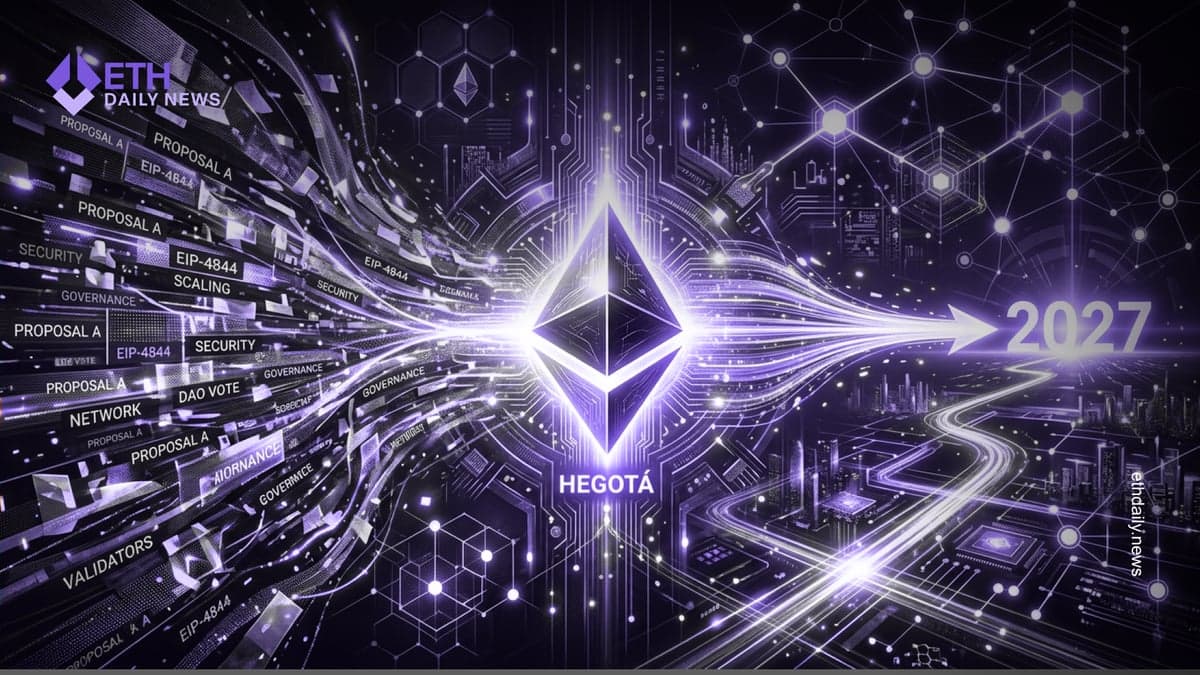
Ethereum developers are narrowing the scope of Hegotá, the network’s planned 2027 upgrade, as teams evaluate proposals focused on censorship resistance, account abstraction, privacy, gas pricing and validator economics.
Ethereum researcher Toni Wahrstätter said on Aug. 16 that 66 proposals were being considered as part of the broader Hegotá discussion.
However, the figure does not mean Ethereum has approved 66 features. The official Hegotá Meta EIP currently identifies FOCIL as the only feature scheduled for inclusion, while Frame Transactions is being considered alongside numerous other proposals.
Ethereum.org currently places Hegotá in 2027, following the Glamsterdam upgrade targeted for Q4 2026.
FOCIL remains Hegotá’s primary scheduled feature
The leading proposal for Hegotá is EIP-7805, known as Fork-Choice Enforced Inclusion Lists, or FOCIL.
EIP-7805: Fork-Choice Enforced Inclusion Lists
FOCIL is designed to strengthen Ethereum’s resistance to transaction censorship as block construction becomes increasingly concentrated among specialized builders.
Under the proposal, a committee of validators would create transaction inclusion lists that block builders are expected to respect. Validators could reject blocks that improperly exclude transactions meeting the inclusion requirements.
The goal is to make it more difficult for block builders to selectively censor transactions while preserving Ethereum’s existing proposer-builder separation architecture.
FOCIL is currently the only Hegotá proposal formally scheduled for inclusion, meaning other proposals remain subject to developer review and implementation decisions.
Frame Transactions could bring native account abstraction
Another major proposal under consideration is EIP-8141, known as Frame Transactions.
EIP-8141: Frame Transactions
The proposal would introduce a programmable transaction framework that could allow Ethereum accounts to define how transactions are validated, executed and paid for.
Potential applications include:
Alternative signature schemes
Key rotation
Gas sponsorship
More flexible transaction validation
Reduced dependence on traditional ECDSA authentication
Wahrstätter has argued that Frame Transactions should be considered alongside FOCIL, Keyed Nonces and Recent Roots as part of a broader native privacy and account-abstraction architecture.
However, that remains a proposal rather than a final Ethereum developer decision.
Developers are expected to compare EIP-8141 with EIP-8130 during an Aug. 25 breakout session, with a decision targeted for the Aug. 27 All Core Developers Execution meeting.
The outcome could determine whether native account abstraction becomes part of the eventual Hegotá feature set.
Ethereum developers are also reviewing gas repricing
Several Hegotá proposals focus on Ethereum’s gas model and the ability to safely increase block capacity.
EIP-8131 proposes a minimum transaction-content cost of 64 gas per user-controlled byte. The objective is to ensure that transaction data consumes an appropriate amount of block resources.
EIP-8279 applies similar accounting principles to Block Access List data. The proposal seeks to prevent blocks from becoming substantially larger than their intended computational limits as Ethereum increases its gas capacity.
Another proposal, EIP-8368, would adjust state-creation pricing as Ethereum’s block gas limit increases beyond the reference level planned for Glamsterdam.
Developers have discussed the proposal in the context of a possible future path toward a 600 million gas limit, although the parameters remain under development.
Glamsterdam itself is currently targeting a 200 million gas limit, alongside other Layer 1 scaling improvements.
Privacy is becoming a larger part of Ethereum’s upgrade roadmap
Privacy has also emerged as an important theme across the Hegotá proposals.
Frame Transactions could provide more flexible transaction authentication and execution, while FOCIL could help prevent censorship of privacy-focused transactions.
Other proposals, including EIP-8250 and EIP-8272, are also listed among the broader Hegotá candidates, although neither is currently scheduled for inclusion.
This reflects a broader shift in Ethereum’s roadmap toward improving not only scalability and transaction capacity but also the privacy and flexibility available to users and applications.
The network's approach is increasingly focused on building infrastructure that allows wallets, decentralized applications and users to interact with Ethereum without relying exclusively on traditional externally owned accounts and standard transaction flows.
Validator economics and post-quantum security remain under discussion
Hegotá discussions extend beyond transactions and gas pricing.
Developers are also evaluating proposals involving validator economics, staking and long-term network security.
One proposal, EIP-7716, explores anti-correlation penalties for validators. The idea is to modify validator penalties in ways that could reduce incentives for correlated validator behavior.
Other proposals involve potential changes to ETH issuance and preparations for post-quantum cryptography.
These ideas remain at different stages of development and should not be considered confirmed Hegotá features.
The same applies to EIP-8198, which proposes changes involving additional execution slots. It remains a draft and has not been formally selected for the upgrade.
Hegotá feature list could be finalized soon
Ethereum developers are moving toward a much narrower Hegotá scope.
Core developers are expected to finalize the proposed inclusion list toward the end of August, while proposals without active champions could be removed from consideration.
Execution-layer client teams are expected to submit ranked preferences by Sept. 10, giving developers a clearer picture of which proposals have sufficient implementation support.
The next series of developer calls will therefore be critical for determining which proposals move into implementation, testing and eventually devnets.
For now, the distinction between proposed, considered and scheduled features remains important.
FOCIL is currently the only proposal formally scheduled for Hegotá, while Frame Transactions and numerous other EIPs remain under active discussion.
What Ethereum users should watch
The final Hegotá package could have implications for several parts of the Ethereum ecosystem, including:
Privacy: stronger protections against transaction censorship and more flexible transaction execution.
Account abstraction: potentially more powerful smart-account functionality.
Scaling: changes to gas pricing and block capacity.
Validators: adjustments to incentives and penalties.
Security: preparation for future cryptographic threats.
ETH economics: potential changes to issuance and validator-related mechanisms.
With Hegotá still in development, Ethereum’s final 2027 upgrade package could look significantly different from the current proposal list.
For now, FOCIL remains the clearest confirmed component, while the coming developer meetings will determine which additional proposals survive the narrowing process.