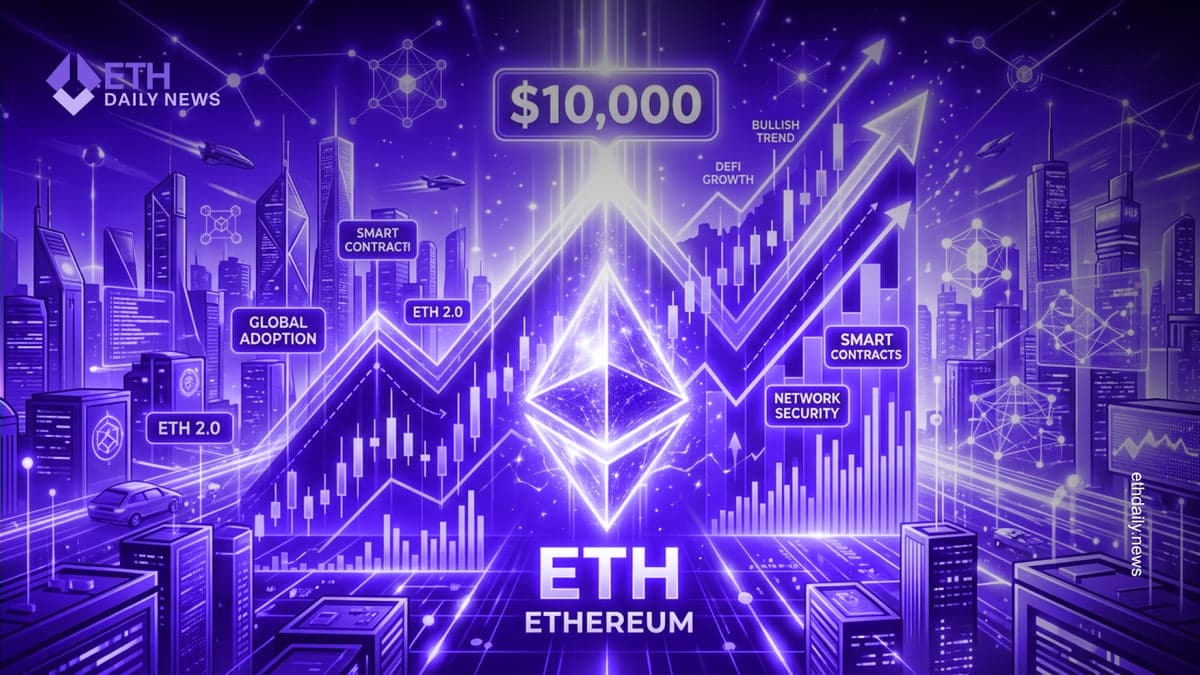
Tom Lee Says Ethereum Could Easily Top $10,000 by 2027–2028
Ethereum could have significantly more upside over the next two years, according to Bitmine chairman Tom Lee, who said ETH could easily trade above $10,000 by 2027 or 2028.
Lee made the prediction during a recent Bankless interview while discussing Ethereum's expanding role in AI, Wall Street tokenization and blockchain-based financial infrastructure. He argued that Ethereum is entering a new phase in which institutional adoption could create substantially more demand for ETH.
The comments come as Bitmine continues aggressively building its Ethereum treasury. On-chain data reported today indicates that an address believed to be linked to Bitmine withdrew 20,000 ETH worth approximately $48.89 million from Kraken. The transaction has not yet been independently confirmed by Bitmine as a purchase, so it should be treated as a reported on-chain movement rather than a confirmed company acquisition.
Tom Lee Sees Ethereum Above $10,000
Lee's $10,000-plus outlook is based on several structural trends that he believes could expand Ethereum's role in the global financial system.
During the Bankless discussion, Lee pointed to AI, Wall Street's development of new settlement rails and the tokenization of real-world assets as major potential sources of future demand.
“I think Ethereum could easily be over $10,000 in that time frame.”
Lee was specifically discussing the 2027–2028 period and argued that Ethereum should benefit from a combination of a broader crypto bull cycle, Wall Street tokenization and increasing AI-related blockchain activity.
For the latest official information on Bitmine's Ethereum strategy, readers can follow the company's Investor Relations page.
AI Could Become a Major Ethereum Catalyst
One of Lee's strongest arguments revolves around the growing connection between artificial intelligence and blockchain infrastructure.
He believes an economy increasingly dominated by AI agents and machine-to-machine transactions could require digital-native financial infrastructure capable of handling payments, instructions, settlement and ownership.
Ethereum could potentially play a role in that system because its blockchain infrastructure can support programmable assets, stablecoins, tokenized securities and decentralized applications.
Lee argued that traditional financial settlement systems could become less suitable as AI-driven transactions become more complex and automated.
Bitmine has similarly described Ethereum as a potential infrastructure layer connecting institutional capital, tokenized assets and the emerging AI economy.
Wall Street Tokenization Could Boost ETH Demand
Tokenization is another major part of Lee's Ethereum thesis.
Financial institutions are increasingly exploring blockchain-based representations of stocks, bonds, funds and other real-world assets. Lee believes Ethereum is positioned to benefit if Wall Street increasingly uses public blockchains as settlement infrastructure.
During the Bankless interview, he pointed to the growing involvement of major financial institutions and argued that Ethereum could become one of the primary networks supporting tokenized financial assets.
This would potentially create demand for Ethereum beyond speculative trading.
If more financial assets, stablecoins and applications operate on Ethereum, the network could become increasingly important to institutional financial infrastructure.
Bitmine Continues Building Its ETH Treasury
Bitmine has made accumulating Ethereum the centerpiece of its corporate treasury strategy.
The company describes itself as the world's leading Ethereum treasury company and has established a goal of accumulating 5% of the total ETH supply under its "Alchemy of 5%" strategy.
Bitmine's official investor-relations page reported that its Ethereum holdings had reached 5.82 million ETH by Aug. 17, representing one of the largest corporate Ethereum positions in the market.
The reported 20,000 ETH transfer from Kraken would represent another substantial addition if Bitmine ultimately confirms that the wallet belongs to the company and that the withdrawal was an acquisition.
At roughly $2,445 per ETH, 20,000 ETH represents approximately $48.9 million.
Bitmine's 5% Ethereum Goal Is Coming Into Focus
Bitmine's strategy is built around accumulating enough ETH to control approximately 5% of Ethereum's total supply.
The company has been purchasing ETH consistently while also using staking and other Ethereum-native activities as part of its treasury strategy. Its official materials describe the objective as creating a large-scale Ethereum treasury designed to benefit from the growth of the network and its ecosystem.
That strategy makes Bitmine one of the most important corporate holders for investors tracking institutional Ethereum demand.
The company's accumulation also provides a real-time indicator of how aggressively some institutional investors are positioning for Ethereum's long-term growth.
Ethereum's Role Could Expand Beyond DeFi
Lee's argument is that Ethereum's future opportunity is no longer limited to decentralized finance.
The network could potentially serve as infrastructure for stablecoins, tokenized securities, institutional settlement, AI-driven transactions and digital assets.
That would represent a much larger addressable market than Ethereum's earlier cycles, which were dominated by initial coin offerings, DeFi and NFTs.
Bitmine's own chairman's message has similarly highlighted Wall Street tokenization, stablecoins and AI as major drivers behind its long-term Ethereum thesis.
Why $10,000 ETH Matters
A move above $10,000 would represent a major expansion of Ethereum's market value and would require sustained demand from both crypto-native and institutional investors.
Lee's forecast should therefore be viewed as a bullish scenario rather than a guaranteed price target.
Ethereum would need continued growth in network usage, tokenization, stablecoins and institutional adoption to support the valuation implied by such a move.
Market conditions could also have a major impact. Interest rates, liquidity, regulation and broader cryptocurrency cycles remain important risks.
Bitmine's Latest ETH Move Adds to the Bullish Narrative
The reported 20,000 ETH withdrawal from Kraken adds another potentially significant development to the Ethereum treasury story.
The address involved has been described as likely linked to Bitmine, but the company has not yet publicly confirmed the transaction as an acquisition.
If confirmed, the move would reinforce Bitmine's aggressive accumulation strategy and bring another roughly $48.9 million of ETH into an address believed to be associated with the company.
That would come shortly after Bitmine reported reaching 5.82 million ETH in its official Aug. 17 update.
What Ethereum Investors Should Watch Next
The biggest catalysts for Lee's thesis will be institutional tokenization, AI adoption, stablecoin growth, Ethereum network activity and Bitmine's continued ETH accumulation.
Investors should also watch whether Ethereum can translate increasing institutional usage into sustained demand for ETH itself.
For Bitmine, the next major milestone remains its 5% ETH supply target.
For Ethereum, meanwhile, Lee's $10,000-plus forecast represents a much broader bet: that the blockchain becomes a core settlement and financial infrastructure layer for both Wall Street and the emerging AI economy.
If tokenization and AI develop as Lee expects, he believes Ethereum could easily move beyond $10,000 by 2027–2028. Bitmine's continued accumulation suggests the company is positioning for precisely that long-term scenario.