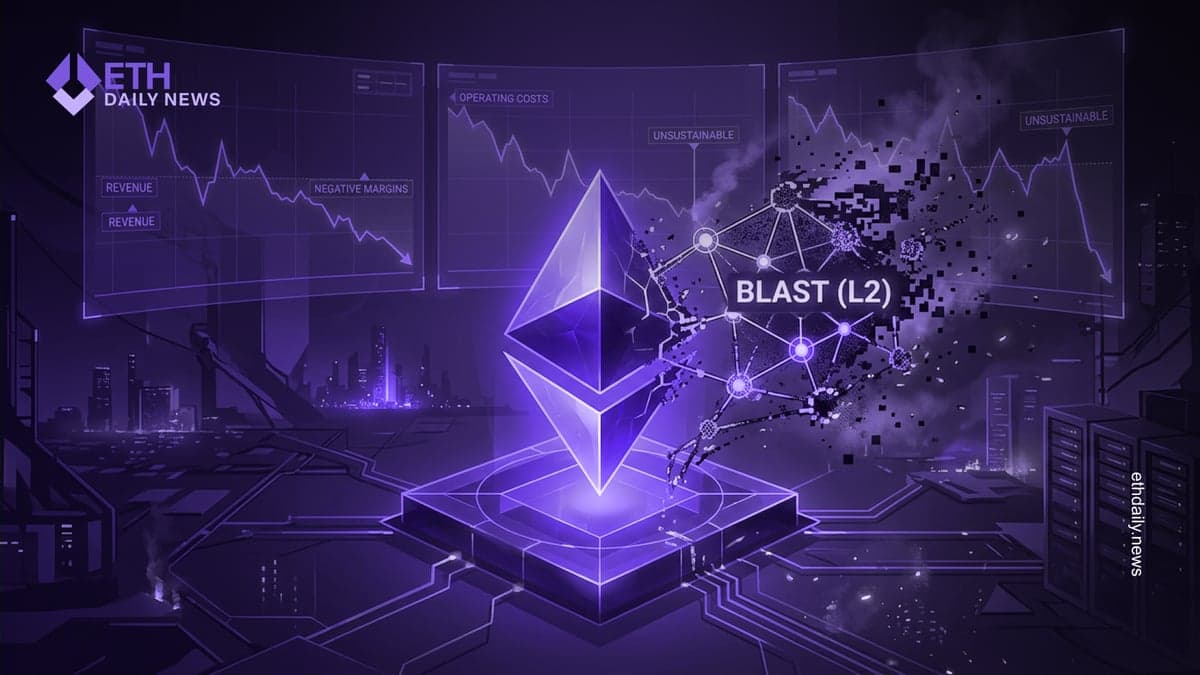
Ethereum Layer 2 network Blast is preparing to wind down operations after a steep decline in activity left the blockchain unable to generate enough revenue to cover its ongoing costs.
The decision marks a sharp reversal for a project that once attracted billions of dollars in crypto deposits and significant attention from Ethereum users. Blast's team said the network no longer has a realistic route toward becoming economically self-sustaining, prompting it to begin an orderly shutdown and ask users to return their assets to Ethereum.
Blast Says Its Layer 2 Model Is No Longer Sustainable
Blast announced the shutdown on October 2, explaining that maintaining the Layer 2 network now costs more than the chain produces in revenue. In its official shutdown announcement on X, the team said it originally intended to create a self-sustaining blockchain for both users and developers.
The project said the economics had changed to the point where continuing operations was no longer viable. Blast stated that its ongoing maintenance expenses exceeded the revenue being generated by the Layer 2 and that the team could not identify a credible route back to economic sustainability. Recent reporting independently confirms that Blast is winding down on this basis.
Blast is part of the broader Ethereum scaling ecosystem. Layer 2 networks process transactions outside Ethereum's base layer while using Ethereum for settlement or security, depending on their architecture. The Ethereum Foundation's Layer 2 overview explains how these networks are designed to increase throughput and reduce transaction costs.
Blast Once Attracted Billions in Crypto Deposits
Blast was created by Tieshun “Pacman” Roquerre, who is also known for founding NFT marketplace Blur. The project entered the market with backing from major crypto investors including Paradigm and Standard Crypto.
Before its mainnet launch in early 2024, Blast generated considerable interest by offering users incentives for bridging assets from Ethereum. More than $2 billion was deposited during its early-access phase, highlighting how quickly incentive programs could attract liquidity to a new Layer 2. The Block reports that the project had raised $20 million and accumulated more than $2 billion in total value locked ahead of the mainnet rollout.
However, Blast entered an increasingly competitive Ethereum Layer 2 market. Networks were competing not only for developers but also for users, liquidity, decentralized applications and transaction activity. Ethereum itself describes Layer 2 development as an ecosystem of independent networks that can both compete and cooperate while extending Ethereum's capabilities.
Blast TVL and Revenue Fell Sharply
The decline in Blast's activity is particularly visible in its total value locked, or TVL. According to DeFiLlama's Blast data, the network now holds only a fraction of the capital it once attracted.
The supplied market data places Blast's current protocol TVL at roughly $32 million, compared with a peak above $2.2 billion in June 2024, around the period of the BLAST token launch. Independent reporting also places the network's remaining value near $32 million.
Revenue deteriorated alongside TVL. The source data shows Blast generated approximately $3.66 million in fees in June 2024, but that figure had fallen to just over $2,000 last month. The collapse in fee generation helps explain the team's conclusion that continuing to operate the chain was no longer financially practical.
BLAST Token Drops Following Shutdown Announcement
The shutdown announcement also put significant pressure on the network's native BLAST token.
According to the supplied market snapshot, BLAST fell by more than 32% over a 24-hour period, reaching approximately $0.00028 and pushing its market capitalization below $20 million. Price percentages reported by other outlets differed depending on when their market snapshots were taken; for example, The Block reported a 17% decline shortly after the announcement.
Using the figures in the supplied report, BLAST has now lost roughly 99% of its value from its 2024 peak of nearly $0.03 per token. The decline illustrates how dramatically the network's market position has changed since the period surrounding its token launch.
Users Asked to Move Assets Back to Ethereum
Blast's immediate priority is helping remaining users withdraw their assets safely. The network has advised users to transfer funds from Blast back to Ethereum mainnet, including balances held through the Blast progressive web application.
The shutdown will occur in stages. Blast is first withdrawing assets held through Lido, a process expected to take around one week. During that period, withdrawals will temporarily be unavailable. After the Lido process is completed, withdrawals are expected to resume with a reduced 24-hour withdrawal delay.
Users have until October 26, 2026 to withdraw using Blast's regular interface. After that deadline, assets are expected to remain recoverable, but withdrawals will require direct interaction with Blast's bridge contracts on Ethereum Layer 1 rather than the standard Blast website. The team says detailed contract instructions will be published before the cutoff.
Founder Reflects on Blast's Short Run
Roquerre acknowledged the shutdown separately in a post from his Pacman account on X.
He said he was disappointed that Blast had not become sustainable over the long term while expressing gratitude to the users, developers and teams that participated in the ecosystem. His statement emphasized that the immediate focus is now on making the wind-down process as smooth as possible.
Blast's shutdown comes as Ethereum continues to rely heavily on Layer 2 networks as part of its broader scaling strategy. The Ethereum Foundation's scaling documentation notes that Layer 2 systems are intended to increase transaction throughput while reducing the burden and cost of executing activity directly on Ethereum mainnet.
For Blast, however, technical scaling was not enough to overcome the economic challenge of maintaining a network after user activity, liquidity and fee revenue declined substantially from their 2024 peaks.